
Why Your Knee Aches Going Down the Stairs (and Where It Really Starts)
August 7, 2026
Contributors

Robbie Stahl


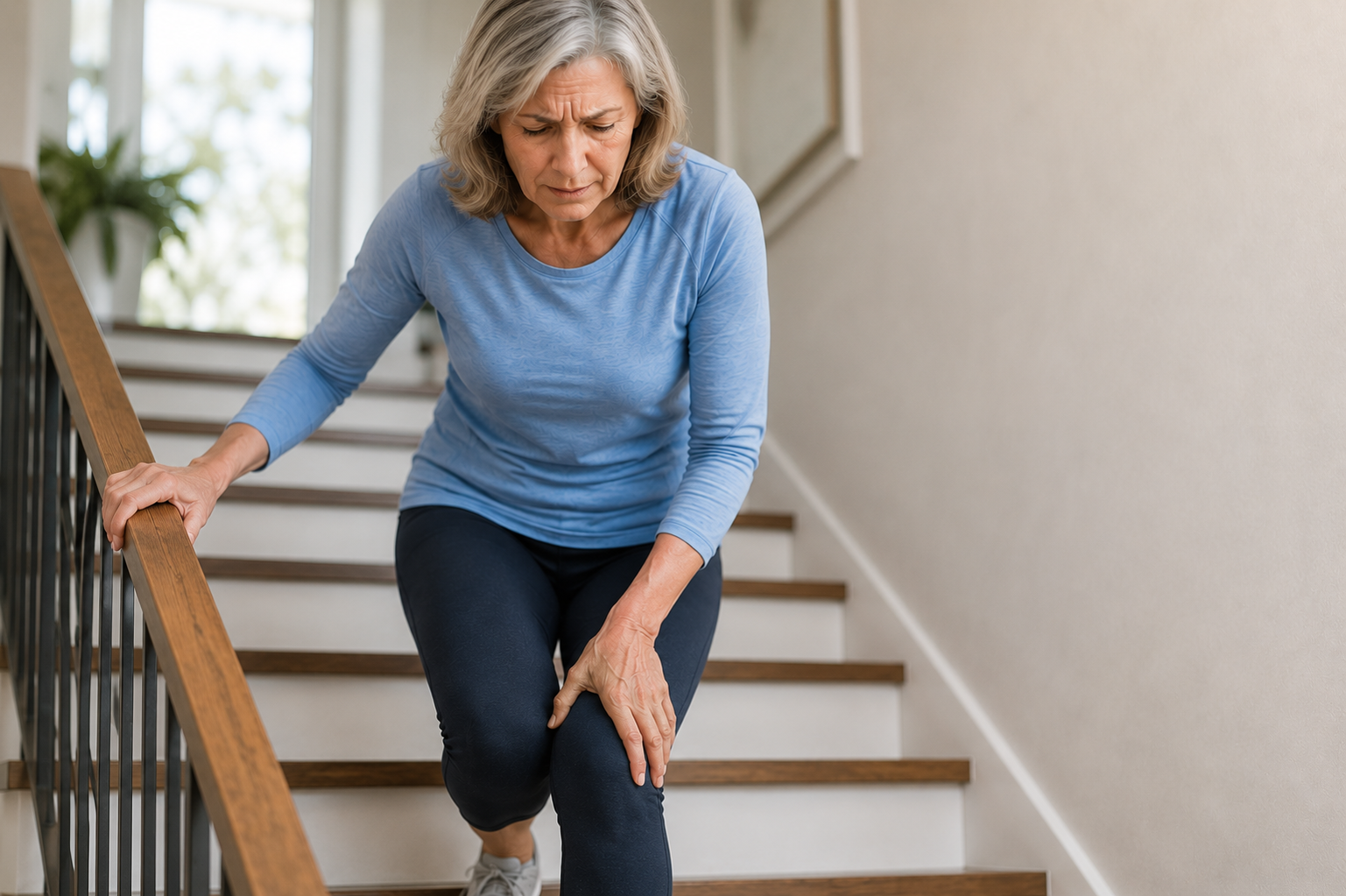
Going up the stairs, your knee is fine. Going down, it pops, cracks, crackles, or grinds. Same step, most days, and now you catch yourself reaching for the rail on the way down.
It's a strange thing to be working around. You're on your feet most of the day. You walk. You carry the groceries in. You just never called any of it exercise.
But that ache going down the stairs often isn't starting in the knee.
Your Knee Is Taking the Blame for Two Places That Don't Hurt
Going down, your knee has to bend under your full weight and lower you to the next step, over and over. That's a big ask, and it's why the trouble shows up there first.
But the knee is often not where the trouble starts. Two other places decide how it holds up, and neither one of them is the knee.
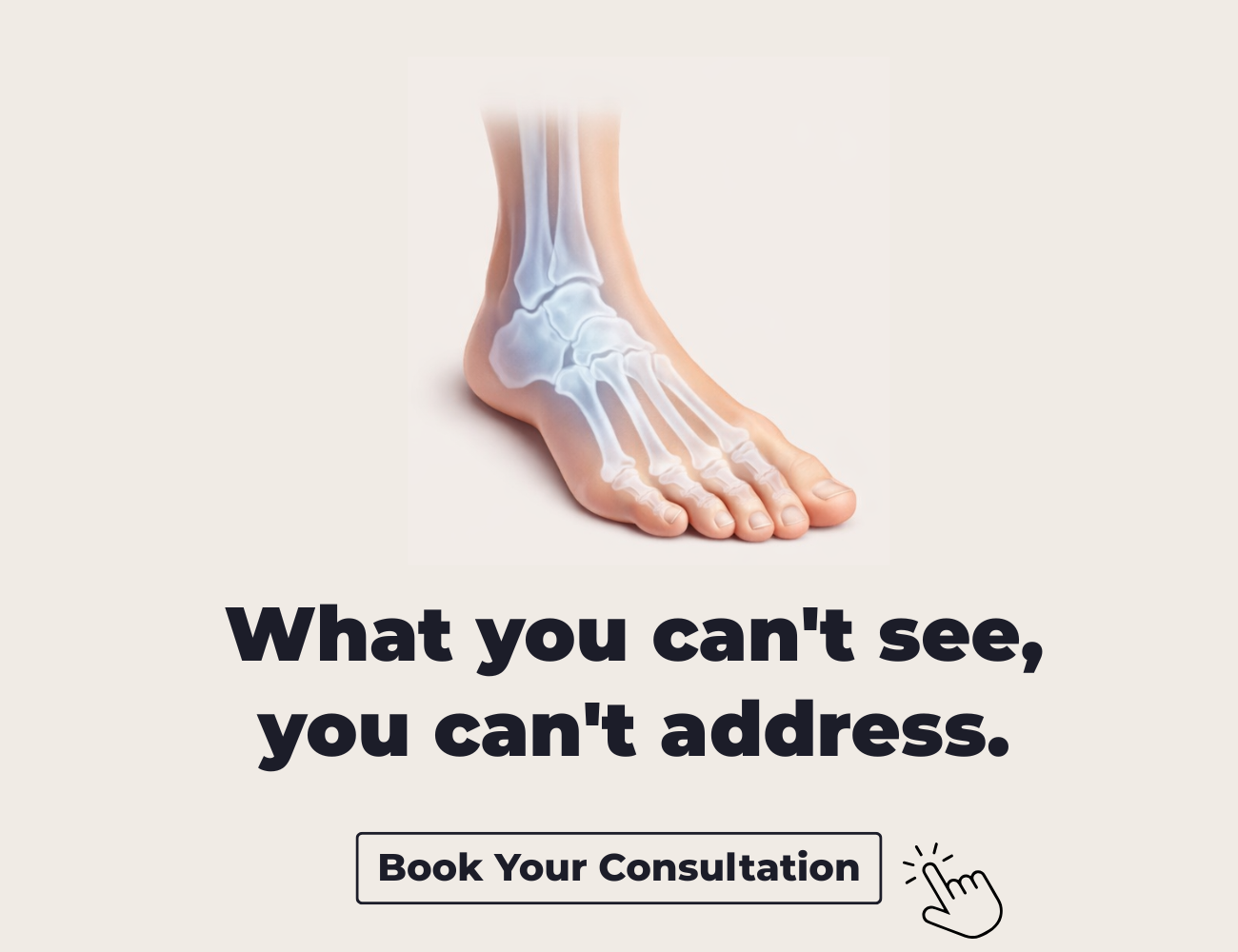
The first sits underneath it. Your foot carries your weight on three points: the pad behind your big toe, the pad behind your little toe, and the center of your heel. What you want across them is even pressure.
What most people do instead is drift, loading one side more than the other, and they have no idea they're doing it. It doesn't look like anything. Nobody watching you would see it.
Think of a table with one leg off by half a centimeter. The leg is barely wrong. The whole top is shifting.
The second place sits above the knee, at the hip. The muscles across your backside and hips are what hold the knee in line while you move, and when they don't do that job, the knee is left to sort it out alone.
Two places, neither of them sore, and one aching knee in the middle.
Why Working the Knee Alone Never Lasts
This is why strengthening, stretching, wrapping, and resting that knee can feel like pouring effort into a bucket with a hole in it. You're working on the part that's out of line, not on the thing putting it out of line.
The two places setting that alignment sit untouched the whole time, so the ache keeps coming back.
And if a program ever had you working that sore knee even harder, it was adding load to a joint that was still crooked. That's not a discipline problem. The effort was simply aimed at the wrong place.
This was never about willpower. The story you've probably been told is that this is just where your body sits now, so lower your expectations. Your age is real, but it isn't the whole verdict, and it doesn't explain why one of your knees is worse than the other.
An ache is a signal. Signals have causes, and a cause you can name is a cause you can work on.
Feel It for Yourself, Right Now
You don't have to take that on faith. Stand up, feet about hip width apart, and put your attention down in your feet.
Find the three points:
- The pad behind your big toe
- The pad behind your little toe
- The center of your heel
Now the question Robbie asks his clients: is the pressure even? Between those two pads on each foot, and between your left foot and your right?
Most people find it isn't. Most people also had no idea, and that's the part worth sitting with.
A drift of sixty-five percent onto one side doesn't announce itself. There's no wobble, no limp, nothing to see. You just stand on it, every day, for years.
Nothing about your knee told you that. Your feet did.
That ten-second check just told you what every stretch you've tried and every white-knuckle trip down the stairs couldn't. Your knee's been taking the blame for the foot under it or the hip over it. Neither one hurts.
You've been standing on it like this for years. Another year won't sort it out.
Book your Functional Movement Consultation, a full hour, sometimes longer, live on video from home with two of our top Fitness Doctor Experts.
The Fix Is Precision, Not More Effort
That's the whole game. What changes the staircase isn't gentler movements or a longer routine. It's working on the place that's actually driving it.
When the pressure evens out across your foot, the knee above it finally gets a level base to sit on. When the hips do their job of holding the knee in line, it stops grinding through every step slightly off-center.
The trick is knowing which of the two is yours, and how much of each, because your knee has its own specific story.
Notice what just happened, though. You could feel the foot one standing in your kitchen.
There is no version of that for the hip, and no version of either one that works while you're actually moving. That's not us holding something back. It's that nobody can watch themselves move.
Someone Who Found Hers
Finding the rest of it is where things actually change. Shoshana is 70.
Here's how she put it at the start: "I'm 70 years old and I have some knee problems and I'm trying to avoid surgery."
Instead of hammering the sore knee, she went after what was actually driving it. Here she is two months later: "I don't walk with a funny gait so much anymore, and it's been, what, two months?"
And after that: "I hiked yesterday in this beautiful forest for two hours, and it had lots of roots and up and down. And I had no pain in my knees."
Her knee was never the whole story either.
The two places this post describes are where other people's knees were being decided, and they weren't in the same spot. Rifka's was below the knee: "My ankle is turning in, so I'm having a hard time balancing on my left leg."
Judy's sat above it: "I started to understand why I've had the foot problems I've had for the last twenty five years and how my glutes are affecting my knees and my feet and my bunions and hammertoes."
Two different places, and the same staircase at the end of it. Here's Teresa: "Going up and down stairs, my knees don't have a little crinkles in them."
Watch them tell it themselves.
See Your Whole Body the Way an Expert Does
That's what a Functional Movement Consultation is for. You get on a live video call from home with two of our top Fitness Doctor Experts, orthopedic specialists in physical therapy and anti-aging fitness.
They watch how you move on camera, and they record it while you do. That's the whole point of it. Afterward they share their screen, play your own footage back, and show you what they saw.
You don't film anything in advance, and you don't send anything in. It all happens live on the call, and it runs a full hour, sometimes longer.
That footage review is the Report of Findings: what's restricted, what's compensating for it, and the one place worth working on first.
The first thing they do is decide whether they can actually help you. Not everyone is a fit, and they would rather tell you that than take your money.
If it is a fit, they'll show you what working together looks like, at the end of the call, and what it costs. You don't decide anything on the call.
Either way the $297 is for the evaluation, and it stands on its own. Even if you never work with them, you leave understanding what your body actually needs instead of bracing against it. Click here to secure your Functional Movement Consultation now >>
You kept moving, and you noticed something was off. You were right. Something is.
Let's find which of the two places is yours, so your knee can stop taking the blame for it.
Robbie Stahl